Now Reading: Es Devlin: we are the ones who shaped AI’s Pandora’s box
-
01
Es Devlin: we are the ones who shaped AI’s Pandora’s box

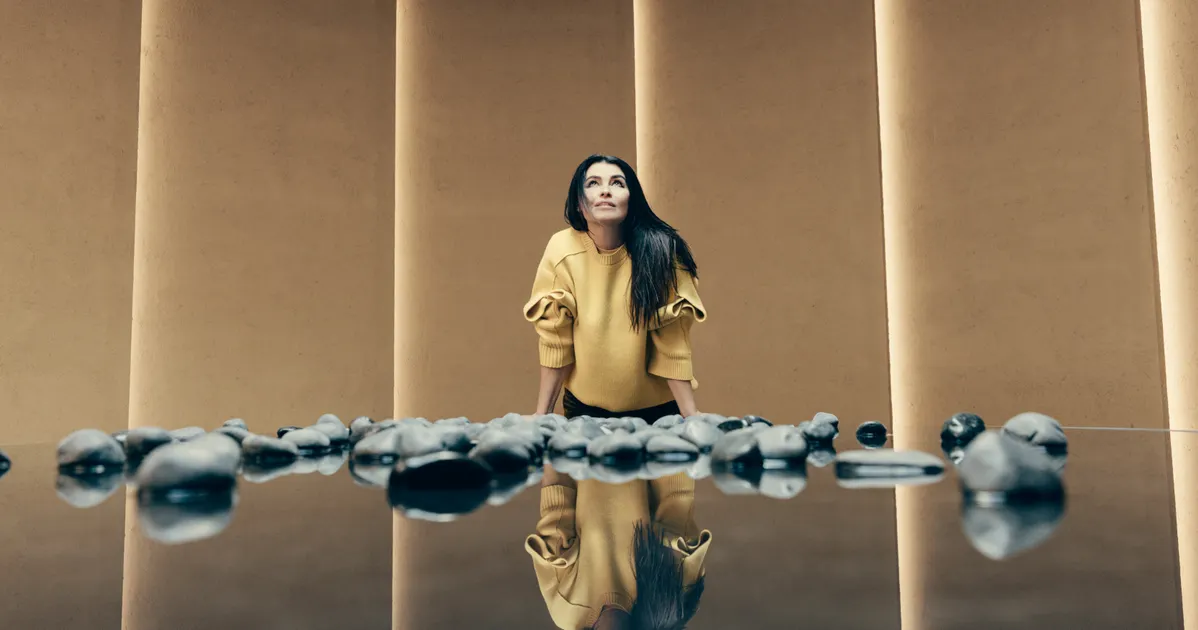
Es Devlin takes artificial intelligence out of technical language and brings it back to matter: clay, symbols, limits, and the relationship between humans and technology.
In the debate around artificial intelligence, everything often takes place within an abstract vocabulary: models, capabilities, performance, scale. The news coming from Oxford moves in the opposite direction. Artist and designer Es Devlin brought together AI researchers, artists, spiritual leaders, and technology experts in a summit called AI and Earth, built around a simple gesture: working with Jurassic clay that is about 160 million years old.
Clay introduces into the conversation about AI something that is usually pushed out: weight, time, touch, limit. A model updates itself; a surface is shaped. A computational system produces output; a material resists. In this sense, the symbol is not ceramics as nostalgia for craftsmanship, but matter as the counterpoint to simulation.
In Devlin’s artistic project, the vessel becomes a central figure. It is an ancient object, but above all it is a form that contains. It does not impose a truth: it welcomes a presence. In an age when AI tends to present itself as a machine that generates, predicts, completes, and replaces, the vessel suggests another idea of technology: not the kind that occupies all available space, but the kind that prepares a space.
It is a subtle but important difference. Much contemporary technology is designed to eliminate friction, waiting, and ambiguity. Clay does the opposite: it dirties the hands, slows the gesture, makes the process visible. That is why Devlin’s choice works symbolically. Bringing AI close to such an ancient material means, for a moment, taking it away from the language of efficiency and placing it back within a more human, earthly, finite frame.
The symbol of the vessel against the illusion of abstraction
According to accounts of the initiative, the meetings took place in a non-hierarchical atmosphere, with people from different fields invited to engage while shaping the earth. This detail matters too. AI is often discussed as if it already had its own clergy: engineers, investors, platforms, executives. Here, instead, a different image appears.
Clay does not “answer” AI. It does not offer a simple moral thesis. But it forces the question to be reformulated. If a technology promises to multiply images, texts, voices, and synthetic identities, what happens when it is forced to measure itself against something that cannot be accelerated without losing meaning?
Anyone who closely follows the way digital systems shape perception and relationships may recognize here a familiar question: what kind of sensibility are we building in the digital environment? And again: if machines learn to imitate language, tone, and companionship, what remains of the experience of an unprogrammed relationship? It is a question that also returns when discussing relationships with artificial intelligence.
360 vessels, not one answer
The summit also gave rise to 360 Vessels, an installation created with composer Nico Muhly for Oxford’s new Schwarzman Centre for the Humanities. The title already says a lot. Not a single vessel, not a definitive object, but a multiplicity of containers. Here, the vessel is not a symbol of compact unity. It is a symbol of plurality: different forms, different hands, different ideas.
And perhaps this is the most interesting aspect of the story. At a moment when AI tends to compress differences into increasingly standardized systems, the vessel returns as a minimal figure of singularity. Every container holds, but not in the same way. Every form is a material decision, every edge implies a boundary, every void has its own measure.
Every technology, before being a promise, is a relationship between form, limit, and the world.
External sources:
The Guardian – What can 160-million-year-old clay tell us about AI and ethics?
Schwarzman Centre, Oxford – Es Devlin and Nico Muhly: 360 Vessels