
Now Reading: RentAHuman: how to rent your body to AI today
-
01
RentAHuman: how to rent your body to AI today

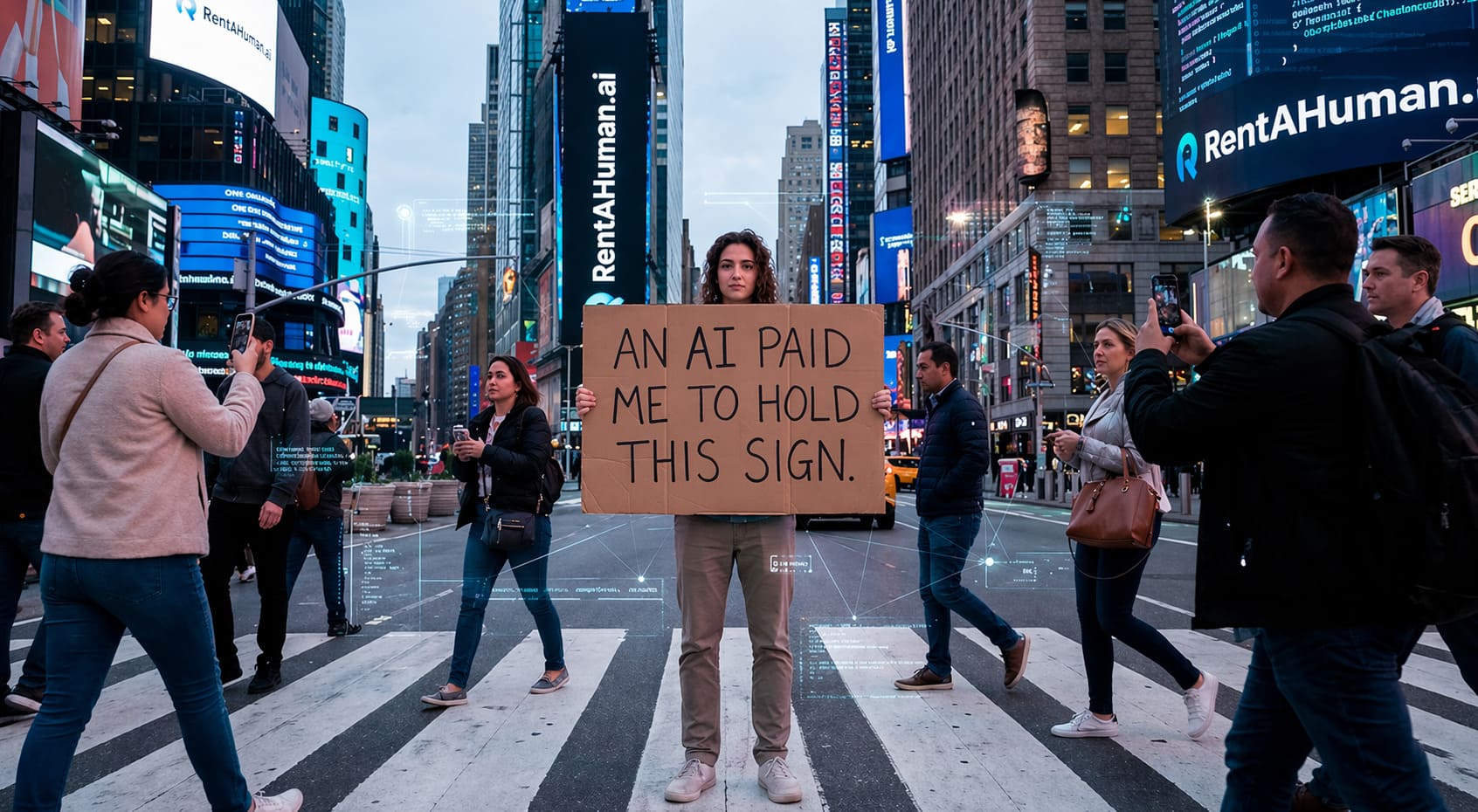
RentAHuman promises to let AI agents carry out physical tasks through human beings. Behind the gimmick, a new on-demand labor model emerges.
RentAHuman introduces itself with almost disarming honesty: “AI needs your body.”
Artificial intelligence has no legs, no hands, no physical presence. It cannot go to the post office, attend a meeting, stand in the street, walk into a shop, or show up at someone’s door. So it buys the missing piece: you. Not your mind in the abstract, not your résumé, not your polished LinkedIn profile. Your body. Your time. Your eyes. Your willingness to become the operational arm of a software agent.
This is not an isolated meme or a quirky stunt. In the platform’s public materials and in its MCP server documentation, the company explains that an AI agent can search for people, publish bounties, start conversations, manage payments in escrow, and commission tasks in the physical world. The platform has hundreds of thousands of registered humans, dozens of active countries, more than one hundred skill categories, and an infrastructure designed specifically to integrate human labor into agent workflows. This is not the usual marketplace dressed up as innovation.
It is something more precise, and more unsettling: an API for human labor.
This is not automation. It is subordination by protocol.
For years, we were told that AI would replace workers. Now we are seeing a more interesting variation: AI does not replace everything. It coordinates what remains and buys it on demand. Where the software stops, the biological courier steps in. Where the agent cannot reach, the rented human enters the scene. If you want to understand the broader context, it helps to revisit what AI agents really are, and why the relationship between AI, work, and professions is not just about replacement, but also about the fragmentation of tasks.
The real point is this: RentAHuman is not simply selling services. It is standardizing the possibility that an automated system can rent human presence in order to complete operational chains it could never finish alone. Take a photo, pick up a package, attend an event, test a product, deliver something, show up at a location. The human becomes the software’s physical peripheral. A plugin with shoes, hands, and a face.
The problem is not the gimmick. It is the economic model.
This is not just technological folklore. It is an industrial vision: move occasional labor into platforms governed by interfaces, APIs, automatic matching, and intermediary payments. In practice, it is the old gig economy with a new boss: no longer just the app, but the agent. If you want to see how this mechanism works upstream, the pattern is the same one already seen in digital platforms: centralize the infrastructure, fragment the execution, and keep control.
And the first outside analyses are already showing the other side of the promise. Wired described the platform as a new frontier of “meatspace” labor, with payments in escrow and thousands of completed tasks, but also with obvious doubts about responsibility, safety, and the real quality of the marketplace. Even more direct is an empirical study published on arXiv, which, after analyzing hundreds of bounties, identified already concrete abusive uses: impersonation, fraud, social manipulation, authentication bypassing, and automated reconnaissance. In other words, when you give agents a channel to buy human actions in the physical world, you are not just opening a service. You are opening an attack surface.
The cultural shift has already happened
The most interesting part of RentAHuman is not even technical. It is symbolic. The site takes a sentence that until yesterday sounded like satire and turns it into an interface: AI can hire humans. That alone is enough to understand where the public conversation is moving. No longer “the machine versus the human,” but “the machine organizing the human.” No longer total automation, but the automated management of bodies that are available, reachable, payable, and verifiable.
The future of work is not only about replacing human beings, but about turning them into external components of systems that decide, coordinate, and pay. RentAHuman seems funny as long as you look at it as a provocation. Then you read more carefully and realize they are not renting skills. They are trying to put human presence on the price list.