Now Reading: On This Day… 1776: How AI Is Rewriting the American Revolution
-
01
On This Day… 1776: How AI Is Rewriting the American Revolution

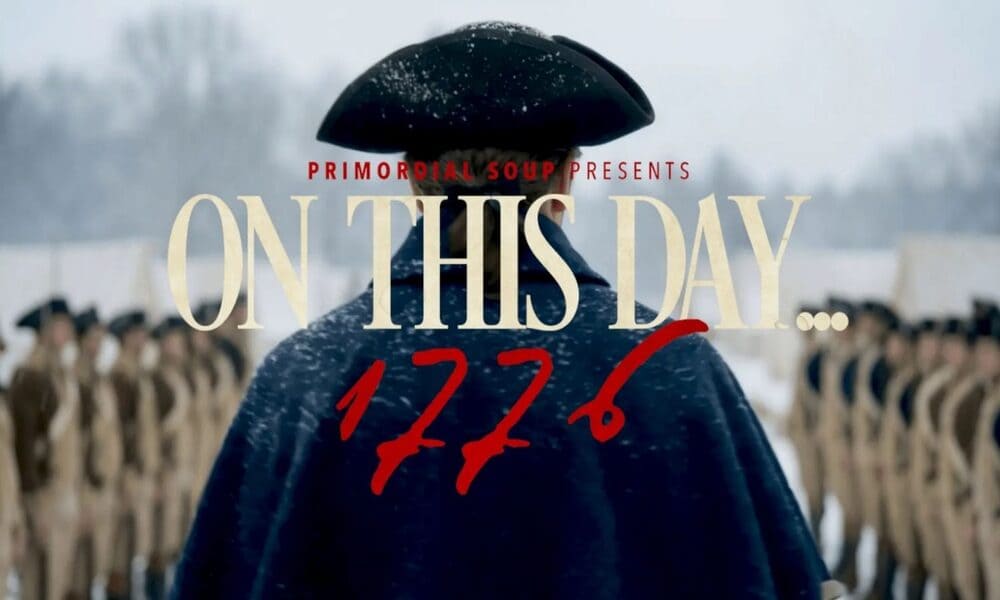
On This Day… 1776, Darren Aronofsky’s new experimental animated series, sparks debate over artificial intelligence, authorship, and historical memory.
On This Day… 1776 is the new animated series produced by Darren Aronofsky (Black Swan, Pi, An Inconvenient Truth) that is drawing international attention for its openly stated use of artificial intelligence in historical storytelling. The project reconstructs key events of the American Revolution, releasing each episode on the exact 250th anniversary of the events it depicts.
The first episodes are already available on Time’s official YouTube channel, outlining a narrative arc that is unfolding throughout 2026.
On This Day… 1776: the timeline of a reawakening consciousness
The structure of On This Day… 1776 is one of the project’s most innovative elements. Each episode is short, self-contained, and tied to a specific date in 1776, the founding year of the United States.
This is not a linear narrative, but a work of surgical editing through historical shorts, focused on tightly framed moments: decisions, hesitations, gestures that seem minor on the surface.
This fragmented seriality takes on a function that is not merely representational, but reactivating: the past is stirred back into motion, and historical achievements become a field of possibilities visually reformulated in the present.
The role of artificial intelligence in the production of On This Day… 1776
The series was developed by Primordial Soup, Aronofsky’s studio, and uses generative AI tools for animation and visual composition, while still maintaining a human pipeline for screenwriting, voice acting, and post-production.
According to the creative team, the goal is not to automate creativity, but to experiment with a human-machine collaboration. In this process, AI is able to generate forms loaded with meaning while operating through a rationality without experience, a mode of thinking without any real lived reality behind it.
The result is a deliberately unstable aesthetic that has already sparked debate among critics and audiences about the boundary between technical tool and co-authorship.
An aesthetic of uncertainty: the uncanny valley as a liminal stimulus
From a visual standpoint, On This Day… 1776 presents images that oscillate between realism and abstraction. Historical figures such as George Washington, Benjamin Franklin, and Thomas Paine appear recognizable, yet never fully fixed, as if they were still in the process of being defined.
The uncanny valley is not a technical flaw here: it is a language consistent with the historical subject, because looking at the “almost human” produces that unease and repulsion that forces the viewer to take a position on what is being represented.
The American Revolution is not shown as a completed founding myth, but as a fragile, unfinished, ambiguous process. Washington, Franklin, and Paine are not icons: they are hypotheses of man, figures in transition, much like the images that portray them.
Darren Aronofsky between continuity and experimentation
Despite its strong technological component, On This Day… 1776 fits coherently within Aronofsky’s authorial path and artistic poetics.
The central themes of his filmography return here: control and loss of control, rationality and obsession, the transcendent tension between order and chaos, both on the historical and the medial plane.
Here, the body is history, the mind is a machine put on trial because it has understood everything except what matters most, and the soul, if it exists, is left in the hands of the viewer.