
Now Reading: The Humanoid Robot Marathon in China: Spectacle or Industrial Dress Rehearsal?
-
01
The Humanoid Robot Marathon in China: Spectacle or Industrial Dress Rehearsal?

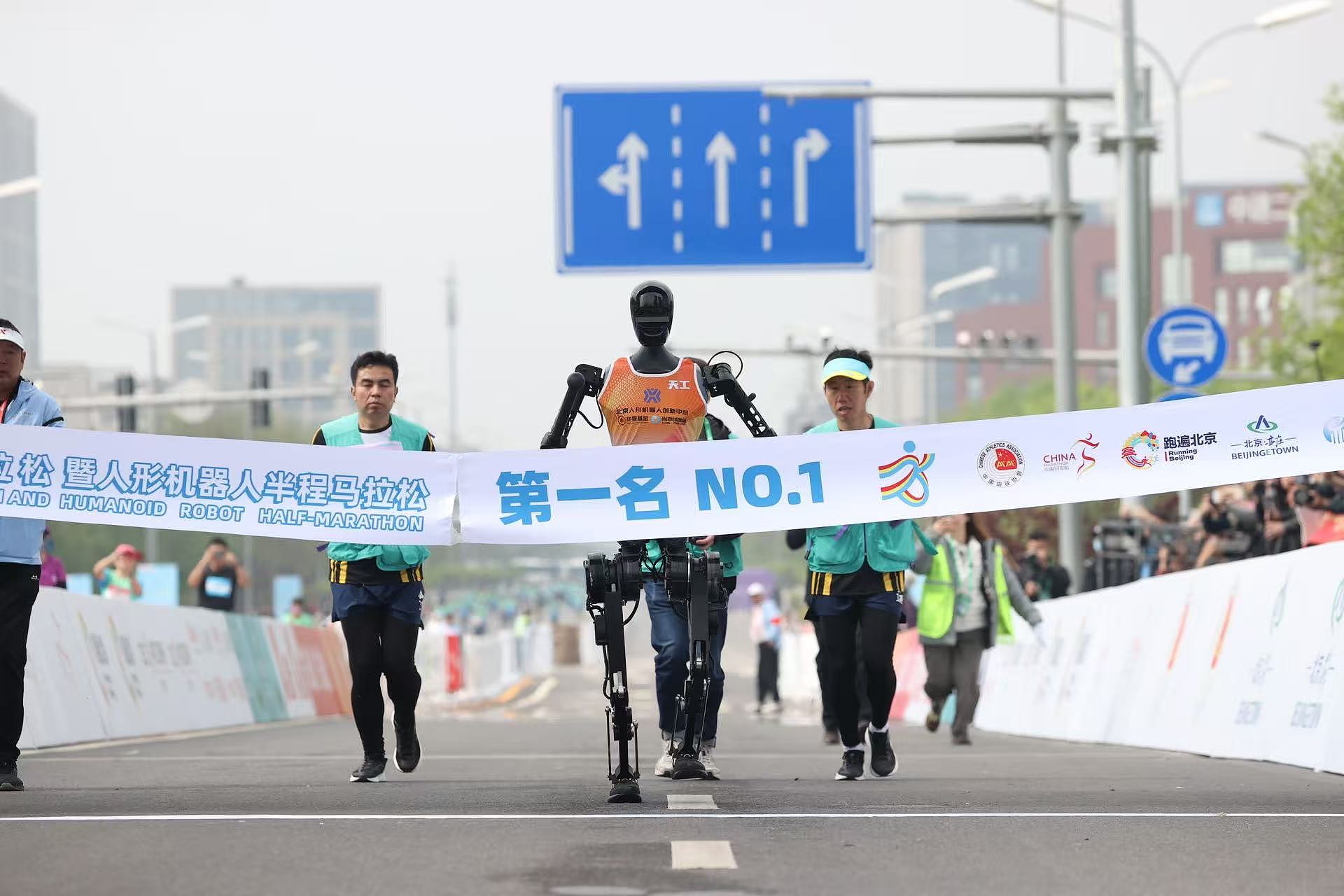
China’s humanoid robot marathon is more than a spectacle: it is an industrial showcase revealing the ambitions, limits, and power of the robotics industry of the future.
Sunday, April 19, Beijing is hosting the second humanoid robot half marathon. Put that way, it sounds like an Expo gimmick, a social-media absurdity, the kind of video people share with that half-amused, half-unsettled expression. But that is not really the point. More than 300 robots are competing, with over 70 teams, on a 21-kilometer course that includes paved inclines and park sections, and nearly 40% of the participants are expected to tackle it autonomously. This is not a Sunday circus. It is a public demonstration of technical capability, organized in the most Chinese way possible: big numbers, controlled staging, and an unmistakably industrial message.
Last year all the robots were essentially remote-controlled runners. This time, a substantial share will have to rely on sensors, perception, decision-making, balance, and energy management. That alone is enough to show the leap. A humanoid robot walking in a lab makes for a nice demo. A robot running outdoors for kilometers, avoiding obstacles, keeping pace, not smashing into barriers, and not sitting down because its battery dies belongs to a different category. Not the category of a worker ready to replace humans in factories, כמובן. But the category of a physical platform that one day might.
The race is meant to showcase a supply chain, not win a medal
This is where it helps not to be fooled by the surface. The robot running is not there to prove that tomorrow it will carry boxes in a warehouse or assemble components better than a skilled worker. It is there to show that China has already brought together parts, capital, companies, data, and national narrative around the same direction. China accounts for more than 80% of the roughly 16,000 global humanoid installations in 2025. Domestic leaders such as AgiBot and Unitree have already shipped thousands of units, while UBTech aims to launch 10,000 full-size robots in 2026. At this level, the marathon is not sport. It is state marketing.
To be clear: when a country closes off a district, puts robots in the street, makes them run in front of cameras and investors, and frames the whole thing as “physical AI” becoming a strategic sector, it is not organizing a quirky event. It is telling the world that it wants to turn humanoid robotics into an economic infrastructure. It is the same logic through which consensus is built around emerging technologies: first the promise is staged, then the capital arrives, then manufacturing is pushed to serve that promise.
The robots are running, but real work is still far away
The interesting part is that insiders themselves are hitting the brakes. Several experts explain that running a half marathon is not the same as being useful in serious industrial settings, where what matters is dexterity, adaptation, perception of the real world, and the ability to handle non-repetitive tasks. One of the entrepreneurs quoted described the state of the sector as something like “dancing disguised as working.” Stripped of the gloss: many robots today look like they are working, but they are still doing choreography.
And this is where it becomes genuinely interesting. Because the bottleneck is not only mechanical. It is above all software. Better models are needed, faster response times, high-quality data collection, training in real-world environments, energy continuity, and lower costs. In other words, it needs the same fuel that already drove generative AI: data, compute, iteration, and enormous industrial patience. That is why humanoid robotics should not be read as a separate chapter. It is one of the fields in which artificial intelligence changes the system by stepping դուրս the screen and trying to enter the physical world.
Behind the marathon lies a simple question: who will control automated labor
In the end, the question is not whether these robots make us laugh. It is who will build the value chain once they stop being funny. If China manages to dominate this segment too, it will not just sell machines: it will sell standards, components, industrial dependence, and automation capacity. And that has much more to do with power than with technological curiosity. In the end the point is always the same: whoever enters the operational layer of machines also enters the layer of control. That applies to software, to clouds, to robotics, to the whole knot of power, technology, and control.
The robot that stumbles is funny. The system that mass-produces it is a lot less so.